RESEARCH > Antimicrobial Peptides
We are identifying and analyzing antimicrobial peptides(AMP) as antibiotics alternatives and developing a method for a large scale production of AMPs.
Identification & Analysis of AMPs
Identification and analysis of antimicrobial peptides(AMP) as antibiotics alternatives
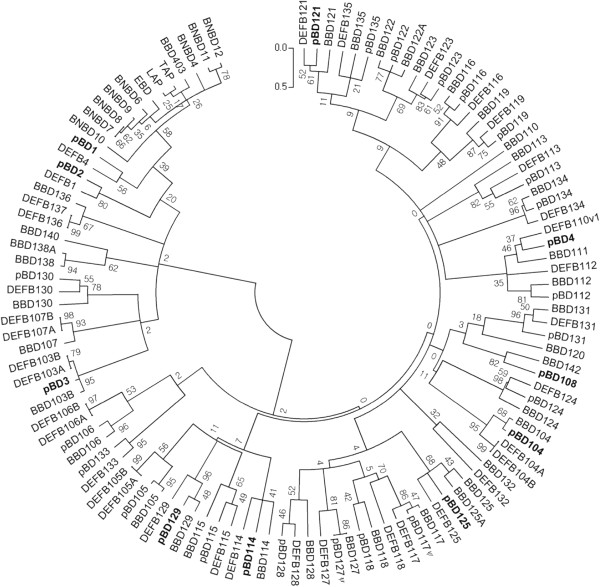
In this study, we characterized 29 functional β-defensin genes in the pig genome on the basis of sequence homology to previously reported β-defensin genes and the conserved 6-cysteine motif. We compared the evolutionary conservation of β-defensin genes among humans, cattle, and pigs, and analyzed their expression patterns. We also report SNPs in the mature peptide region of porcine β-defensin genes.
RELATED PAPERS
- Min-Kyeung Choi, Minh Thong Le, Dinh Truong Nguyen, Hojun Choi, Won Kim, Jin-Hoi Kim, Jungwan Chun, Jiyeon Hyeon, Kunho Seo and Chankyu Park. Genome-level identification, gene expression, and comparative analysis of porcine ß-defensin genes. BMC Genetics 13:98, 2012. PMID 23150902
Large-scale Production of AMPs
Development of a method for a large scale production of antimicrobial peptides
Growing number of multidrug antibiotic resistant pathogenic microorganism is hugely considered as a serious issue in the health industry. Recently, antimicrobial peptides (AMPs) received substantial interest due to their high activity against the board range of pathogenic microorganism including multidrug resistant microorganisms. However, due to their extreme toxicity and proteolytic degradation, the mass production of AMPs by conventional heterologous expression system is still facing challenges to be addressed. Productions of these highly toxic proteins such as short AMPs in Escherichia coli, several methods such as insoluble and soluble fusion partner systems were available. However, these strategies have serious limitation in terms of high yield.
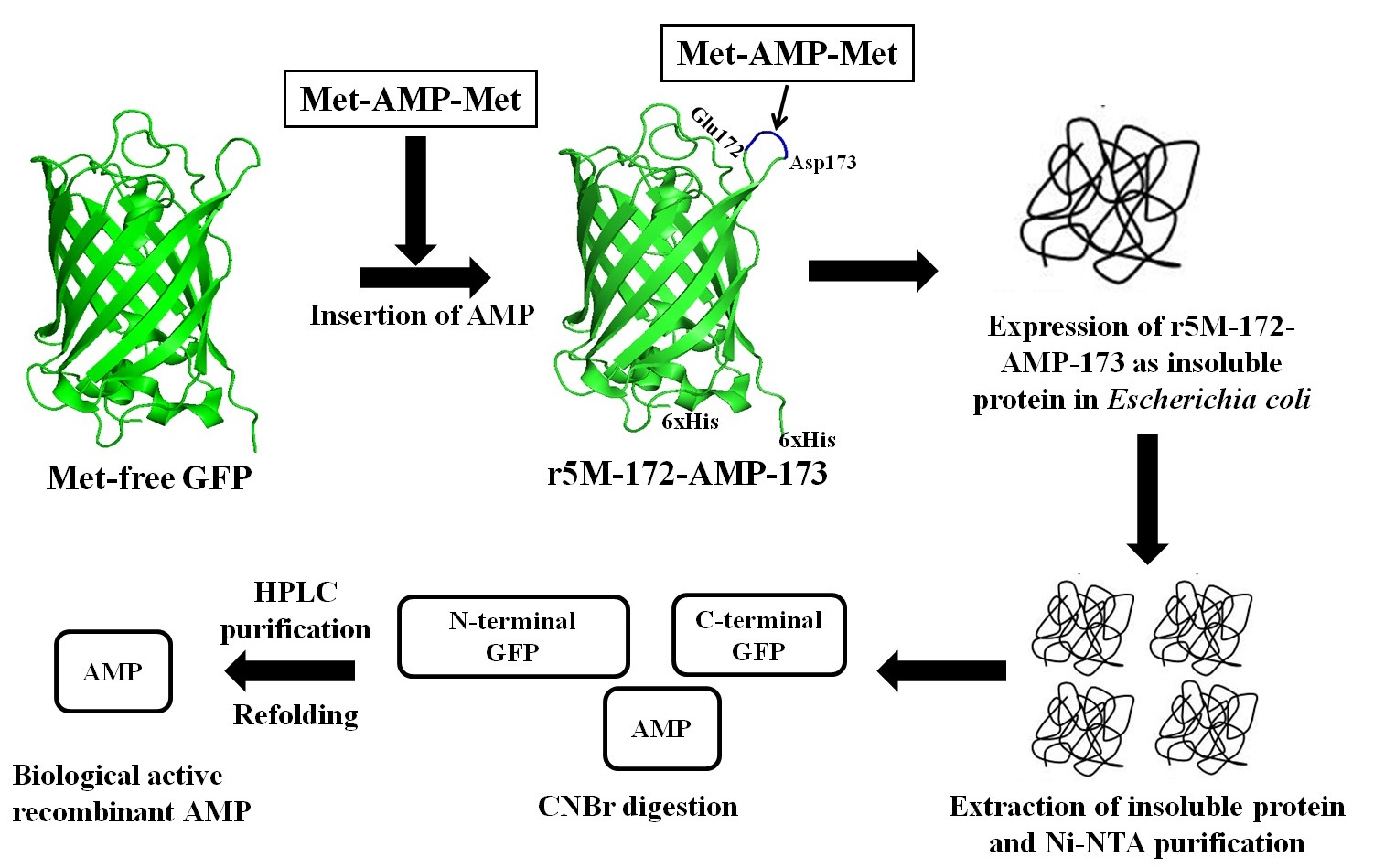
Recently, we have developed a highly simple, robust, and cost-effective method for the large-scale production of these bacteriotoxic peptides such as AMPs in E. coli. We simply inserted the AMPs into the scaffold of the engineered Green fluorescent protein (GFP) in a loop region and expressed them as insoluble proteins in high yield (Figure.), circumventing the inherent toxicity and proteolytic degradation of AMP production in E. coli. Indeed, we were able to successfully demonstrated that this method which can achieve high efficiency production at large-scale for biologically active antimicrobial peptides and other bacteriotoxic proteins for variety of application.
RELATED PAPERS
- Nagasundarapandian Soundrarajan, Hye-sun Cho, Byeongyong Ahn, Minkyung Choi, Le Minh Thong, Hojun Choi, Se-Yeoun Cha, Jin-Hoi Kim, Choi-Kyu Park, Kunho Seo, Chankyu Park. Green fluorescent protein as a scaffold for high efficiency production of functional bacteriotoxic proteins in Escherichia coli. Scientific Reports 6: 20661, 2016. PMID 26864123
AMP Expression Patterns in Pig
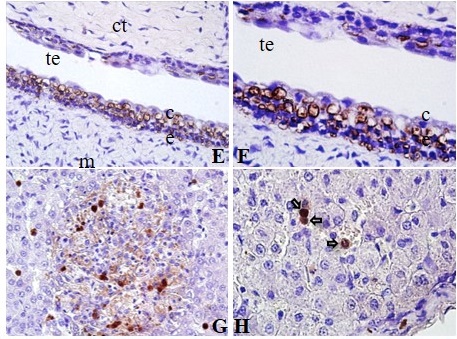
Protegrins (PGs) are potent antimicrobial peptides that act on a broad spectrum of microorganisms, including bacteria, fungi and some enveloped viruses. We analyzed the expression pattern of protegrins in 17 different pig tissues using RT–PCR, and developed an anti-(PG–1) polyclonal IgG. Western blot analysis using the antibody showed that protegrins are mainly present as prepropeptide forms in normal tissues, rather than as mature peptides. Immunohistochemical analysis showed that protegrin expression was specific to a few cell types, including neutrophils, pulmonary club, epithelial and Leydig cells. Genetic analyses of the five previously reported protegrin sequences showed that they are encoded at a single locus, rather than from multiple paralogous genes. By genotyping 28 animals across five breeds, we identified eight different alleles of the PGs.
RELATED PAPERS
- Choi MK, Le MT, Cho H, Soundrarajan N, Jeon H, Park CK, Cha SY, Kim JH, Seo K, Park C. Defining the genetic relationship of protegrin-related sequences and the in vivo expression of protegrins. FEBS JOURNAL 281(24):5420-31, 2014. PMID 25264901