RESEARCH > Immunogenetics & Disease Resistance
Swine Leukocyte Antigen (SLA)
In our laboratory, we are conducting several promising projects related to SLA research:
- Development of comprehensive high resolution typing methods of SLA genes using genomic DNA and direct sequencing.
- Screening of interaction between SLA and antigenic peptides for vaccine development.
- Association study between SLA and early die in piglets.
- Establishment of SLA diverse immortalized cell lines.
- Characterizing the linkage between SLA genes and olfactory receptor genes in pigs.
- Refine the SLA region map as reference for typing using NSG technique.
The major histocompatibility complex (MHC) of pigs, also referred to as swine leukocyte antigens (SLA), is encoded by one of the most polymorphic regions of the pig genome, consisting of a group of genes designated as SLA class I and II systems. SLA proteins function mainly by presenting self- and non-self peptides on the surface of cells to T lymphocytes playing a vital role in the development and control of the swine immune system.
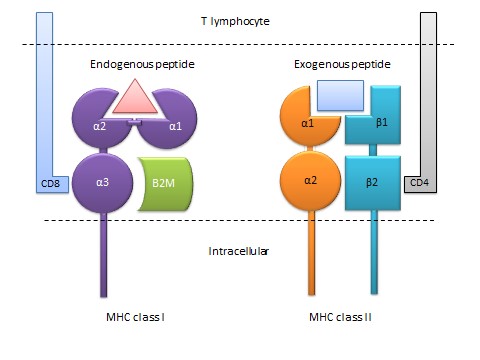
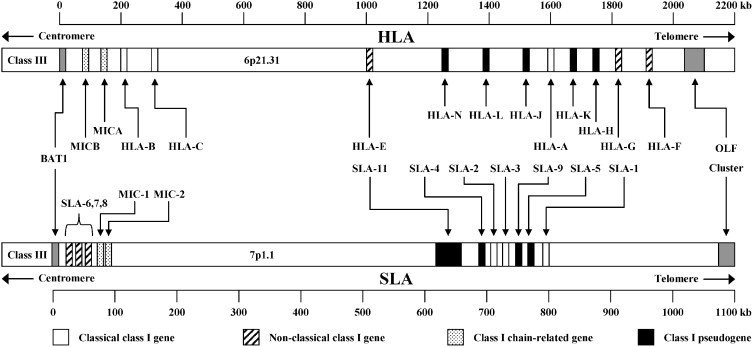
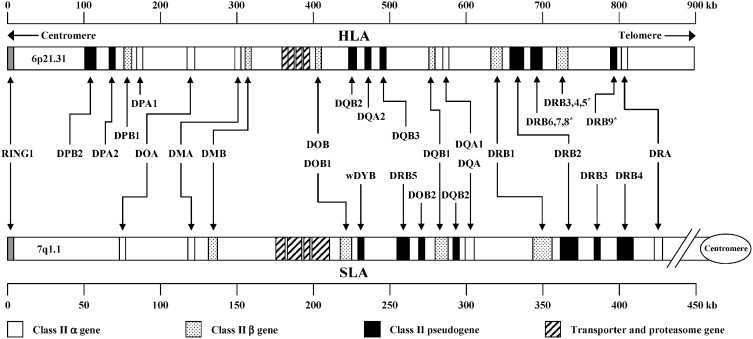
Numerous studies repeatedly showed the association of the SLA complex with immune responsiveness, disease resistance, and susceptibility, as well as reproductive performance and production characteristics. Moreover, pigs have served as an important nutritional source, as well as a valuable model to biomedical research, and possible organ or tissue donors for xenotransplantation. Therefore, SLA genes is one of emergent interested markers for program of Marker Assistant Selection (MAS) breeding, population genetics and immunology.
RELATED PAPERS
- Choi H, Le MT, Lee H, Choi MK, Cho HS, Nagasundarapandian S, Kwon OJ, Kim JH, Seo K, Park JK, Lee JH, Ho CS, Park C. Sequence variations of the locus-specific 5' untranslated regions of SLA class I genes and the development of a comprehensive genomic DNA-based high-resolution typing method for SLA-2. TISSUE ANTIGENS 86-4 255~266, 2015. PMID 26381046
- Dadi H, Le M, Dinka H, Nguyen D, Choi H, Cho H, Choi M, Kim JH, Park JK, Soundrarajan N, Park C. Genetic Diversity and mRNA Expression of Porcine MHC Class I Chain-Related 2(SLA-MIC2) Gene and Development of a High-Resolution Typing Method. PLOS ONE 10-8, 2015. PMID 26305091
- Le M, Choi H, Choi MK, Cho H, Kim JH, Seo HG, Cha SY, Seo K, Dadi H, Park C. Development of a simultaneous high resolution typing method for three SLA class II genes and SLA-DRB1 and the analysis of SLA class II haplotypes. GENE 564-2 228~232, 2015. PMID 25824383
- Minh Thong Le, Hojun Choi, Min-Kyeung Choi, Dinh Truong Nguyen, Jin Hoi Kim, Han Guek Seo, Se Yeon Cha, Kunho Seo, Taehoon Chun, Lawrence B. Schook and Chankyu Park. Comprehensive and high resolution typing of swine leukocyte antigen DQA from genomic DNA and determination of 25 new SLA class II haplotypes. Tissue Antigens 80:528-535, 2012. PMID 23137324
- Cho HO, Ho CS, Lee YJ, Cho IC, Lee SS, Ko MS, Park C, Smith DM, Jeon JT, Lee JH. Establishment of a resource population of SLA haplotype-defined Korean native pigs. Molecules and cells. 29:1-10, 2010. PMID 20396963
- Park K, Choi H, Thong LM, Kwon OJ, Kim JH, Lee HT, Kim YB, Park SB, Park C. Simple and comprehensive SLA-DQB1 genotyping using genomic PCR and direct sequencing. Tissue antigens. 76:301-310, 2010. PMID 20604896
Disease Resistance Genes
Identification of disease resistance genes in mammals
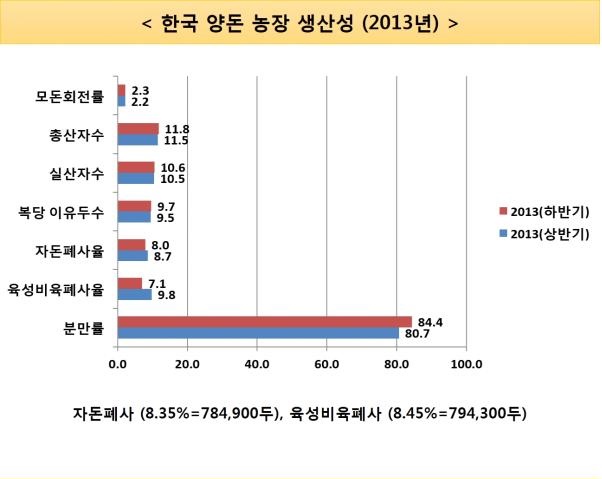
Predicting resistance or susceptibility to infectious diseases on the basis of the genotypes of animals regarding disease or immune related genes could be important in animal production. We are evaluating the potential influence of the genetic polymorphisms of six immune related genes, porcine beta defensin 4 (pBD4), interferon-induced GTP-binding protein Mx1, natural resistance-associated macrophage protein 1 (Nramp1), toll-like receptor 2 (TLR2), alpha (1,2)-fucosyltransferase (FUT1), and tumor necrosis factor alpha (TNFα) on post-weaning piglet survivability in farms. We selected SNPs that satisfied the criteria of nonsynonymous substitutions and the minor allele frequency >0.1 from each gene, and performed PCR–RFLP. For the Nramp1, TLR2, FUT1, and TNFα SNPs, allele and genotype frequencies were significantly different between the two groups consisting of post-weaning survival and non-survival groups (P<0.05). Our results could suggest that the genetic polymorphisms of Nramp1, TLR2, FUT1, and TNFα affect post-weaning piglet survivability. As DNA marker, the availability of SNPs enriched with immune related genes may be important for studies investigating genetic factors related to disease resistance and susceptibility.
RELATED PAPERS
- Hye-sun Cho, Won Kim, Min-Kyung Choi, Minh Thong Le, HoJun Choi, Jin-Hoi Kim, Kyungtae Kim, Nagasundarapandian Soundrarajan, Jin-Ki Park, Yun-Mi Lee, Jong-Joo Kim, Chankyu Park. Effects of Natural Resistance-associated Macrophage Protein 1 and Toll-like Receptor 2 Gene Polymorphisms on Post-weaning Piglet Survivability. Genes and Genomes. 38(2),171-178, 2016. Link
- Kyungtae Kim, Dinh Truong Nguyen, Minkyung Choi, Jin Hoi Kim, Han Geuk Seo, Hailu Dadi, Se-Yeoun Cha, Kunho Seo, Yun Mi Lee, Jong Joo Kim, Chankyu Park. The alpha (1,2) fucosyltransferase M307A polymorphism improves piglet survival. Animal Biotechnology 24:243-250, 2013. PMID 23777352